Mavericks vs Hawks: 7-Step Betting Walkthrough for Oct 17
Why This Fixture Belongs on Your Slip
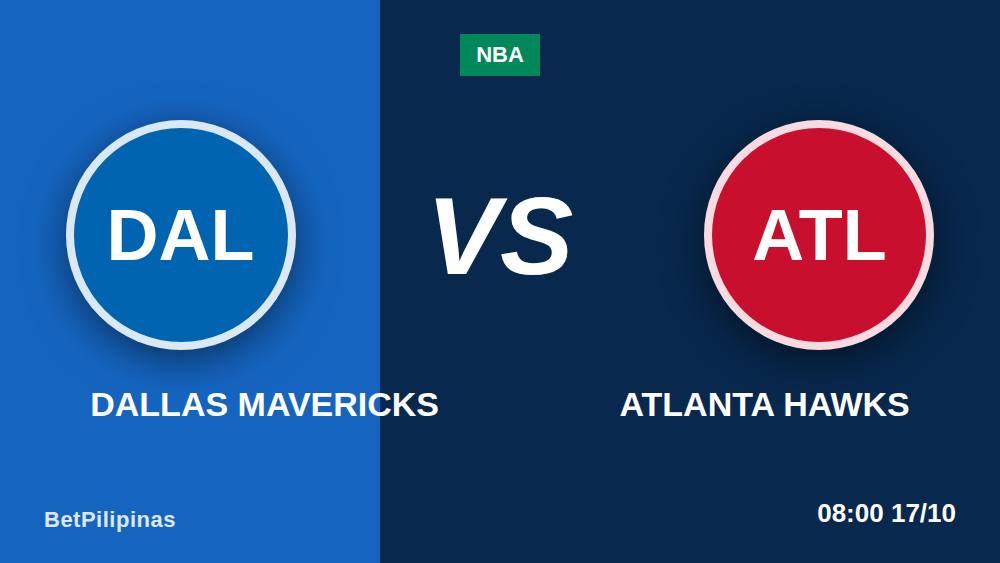
The NBA's 2026/27 regular season is barely out of the blocks, and the schedule makers have handed Philippine bettors a gift: a Friday-night tip-off at the American Airlines Center that lands squarely in our prime-time window. Dallas Mavericks versus Atlanta Hawks, 8:00 AM Manila time on 17 October 2026, and the market has opened tight — DAL -1.5 with a 236.5 total.
That combination is unusually honest. A 1.5-point home line tells you the books see these two rosters as near-identical in strength right now, while a 236.5 number tells you they also expect pace, shooting and very little defensive resistance. Tight spread, fat total — that is a specific kind of game, and it rewards bettors who work through it in order rather than slapping a random pick on it.
This is that ordered process. Seven steps, start to finish, the same way our analysts at BetPilipinas build a slip before they commit a single peso.
| Info | Detail |
|---|---|
| Competition | NBA |
| Kick-off | 08:00 17/10/2026 (GMT+8) |
| Venue | American Airlines Center |
| Dallas Mavericks form | - |
| Atlanta Hawks form | - |
| Reference odds | DAL -1.5 |
| Over/Under | 236.5 |
Step 1: Lock In the Right Sportsbook Before Anything Else
You cannot bet a 1.5-point line properly on a platform that moves slowly. A half-point is the entire margin between cashing and ripping up your ticket here, so the operator you choose matters as much as the pick itself.
For Philippine players, the benchmark is a PAGCOR-licensed bookmaker operating under a valid offshore gaming licence number — the licensed operators we track publish numbers in the PAGCOR Offshore Gaming Licensee format, and any site that hides that number in a footer you have to hunt for is already a red flag. Beyond the licence, here is what a genuinely usable NBA book looks like in 2026:
- Minimum deposit: PHP 200 to PHP 500 for the standard welcome tier. Anything demanding PHP 1,000 before you can see a line is not built for casual Philippine bettors.
- Welcome bonus: 100% match up to PHP 5,000 is the current market standard, with wagering requirements sitting between 5x and 8x the bonus amount. Treat anything above 10x as a bonus you will never clear.
- Withdrawal processing: GCash and Maya payouts should land in 5 to 30 minutes. Bank transfers through InstaPay or PESONet typically clear within 1 to 3 banking hours.
- VIP thresholds: Entry-level VIP usually unlocks at a cumulative PHP 150,000 in turnover, with monthly rebates of 0.3% to 0.5% on sports bets and faster withdrawal queues.
Get that layer settled first. Everything else in this walkthrough assumes you are staking on a platform that pays out without drama.
Step 2: Read the Spread as a Statement, Not a Number
DAL -1.5 is the most revealing line on the board. In the NBA, a home team that is genuinely better than its opponent usually opens somewhere between -4.5 and -7.5. A home line under two points means the oddsmakers believe the venue advantage is doing almost all of the work.
Translate that into what you are actually betting. If you take Dallas at -1.5, you are not betting on the better team — you are betting on the better team plus the home crowd. If you take Atlanta at +1.5, you are betting that the Hawks are the equal or superior roster and simply have to survive 48 minutes without losing by a bucket.
The +1.5 side is the structurally safer position. You get the underdog price, you get the full benefit of a single possession, and you get a cushion that covers one-point losses and buzzer-beater finishes going against you. In a game the market has graded as a coin flip, being on the receiving end of points is a genuine edge over a full season of bets.
If you want Dallas, be honest about why. Take them because you believe the home floor and the pace advantage compound, not because -1.5 looks like a small number. It is small because the books think the game is close.
Step 3: Decide Whether You Trust the 236.5 Total
Now the more interesting number. A 236.5 total is a green light for offence. It signals that the market expects both teams in the 115-122 range, which means high tempo, early shot-clock attempts and — critically — very few meaningful defensive stops in the fourth quarter.
The table below lays out the core market snapshot. Use it as your reference point while you work through the rest of these steps.
Here is the practical question: which side of 236.5 does the shooting variance land on? A total this high only gets cleared if three things happen — both teams shoot above 45% from the field, the three-point volume stays north of 80 combined attempts, and the free-throw count does not collapse in a blowout.
The over is the natural read for a game with a 1.5-point spread. Tight games mean late fouls, and late fouls mean free points in the final two minutes. Blowouts are what kill overs, and this line is telling you a blowout is unlikely.
Rule of thumb we use: when the spread is under 3 points and the total is over 235, the over has quietly been the more reliable side across a full NBA season. The market knows the game is close, and close games go long.
Step 4: Check What the Form Column Is Actually Telling You
The form strings for both sides come into this one blank in the raw fixture data, which is itself informative. In the opening fortnight of the 2026/27 season, nobody has a meaningful W-L streak yet — the sample is two or three games, and a two-game run tells you almost nothing about a roster's true level.
That is why our process leans on situational form rather than raw results at this stage of the calendar:
- Rest differential. A team on the second night of a back-to-back loses roughly 3 to 4 points of implied value. Check the schedule before you stake — this single factor moves more October lines than any injury report.
- Travel. Atlanta coming west into Dallas on a short turnaround is a real tax. A rested Hawks team is a different animal from a road-weary one.
- Rotation stability. Early-season coaches are still tinkering. Teams with settled starting fives outperform their talent on the spread in the first three weeks.
Blank form columns do not mean no information. They mean the information lives somewhere other than the W-L record — and the market has already priced that into a 1.5-point line.
Step 5: Price the Player Props Before You Price the Side
High-total games are prop games. When the market expects 236+ points, the individual scoring and assist lines inflate, and that inflation is where disciplined bettors find the softest numbers on the board.
What we look for on a 236.5 total with a 1.5-point spread:
- Primary scorer points overs. If the two lead guards are posted at 24.5 and 26.5, the pace environment supports the over far more than the under. Take the over on the higher-usage player first.
- Assist lines for the primary playmakers. Fast pace means more possessions, more possessions means more assist opportunities. A posted line of 8.5 assists in a 236-point game is a much friendlier number than the same line in a 210-point game.
- Combined three-pointers made. Books often post 22.5 or 23.5 for combined threes. A 236.5 total almost always comes with a three-point volume expectation above that mark.
- Rebound lines for centres. High pace creates more missed shots, and more missed shots create more rebound chances. This is the most underrated prop angle on a big total.
Stack two or three of these into a same-game parlay and you have leveraged the pace read without needing to be right about the winner.
Step 6: Build the Stake, Not Just the Pick
Knowing the pick is half the job. The other half is sizing it, and this is where most Philippine bettors give back their edge.
Our standard unit framework for a game like this:
- 1 unit = 1% to 2% of your sportsbook bankroll. On a PHP 20,000 balance, that is PHP 200 to PHP 400 per unit.
- Straight spread or total: 1 to 1.5 units. A 1.5-point line carries real variance — never treat it as a lock, no matter how clean the read feels.
- Same-game parlay: 0.25 to 0.5 units maximum. The multipliers are tempting — a three-leg SGP on a 236.5 total can pay north of 6x — but the correlation cuts both ways.
- Live betting reserve: Keep 2 units aside. If Dallas jumps out to an early 10-point lead and the live spread balloons past -8, the value flips hard to Atlanta. Live markets are where a pre-game read gets paid off twice.
If your book is running a 100% welcome match up to PHP 5,000 at 6x wagering, the bonus funds should be staked on straight markets, not parlays. Clearing PHP 30,000 in qualifying turnover is realistic with 1-unit straight bets over a couple of weeks — it is not realistic with 0.25-unit parlays that mostly lose.
Step 7: Time Your Entry and Set Your Exit
Two decisions remain: when to place the bet, and when to let it go.
Timing. For NBA spreads, the sharpest window is usually 45 to 90 minutes before tip-off, after the major injury reports have dropped and the public money has already pushed the line. On a 1.5-point number, a half-point move in either direction is everything. If you can get Dallas at -1 rather than -1.5, take it. If Atlanta drifts to +2, take that instead.
Exit discipline. Decide now, before the ball goes up, what you will do if the game turns. Two rules we follow without exception:
- Never chase a losing pre-game ticket with a live bet on the same game. If the read was wrong, the read was wrong.
- If you are holding an over ticket and the first quarter comes in under 50 combined points, the pace read is already failing. Cash-out offers in the 60-70% range are worth considering rather than riding it to zero.
That is the full walkthrough. Licence-checked book, honest read of the 1.5-point line, a clear stance on 236.5, situational form instead of empty W-L columns, props priced off pace, disciplined unit sizing, and a defined entry and exit. Seven steps, and you are betting this game the way it deserves to be bet.
Where the Value Sits on the Night
Putting the whole picture together: the Hawks at +1.5 is the more defensible side of the spread, because a 1.5-point home line is the market admitting it does not know which team is better. Taking the points costs you nothing and covers a one-point loss.
The over 236.5 aligns with everything the spread is telling you. Close games mean late fouls, and late fouls mean free throws. The only way this total fails is a defensive slog neither roster has shown it can produce.
For props, stay with the pace-dependent markets — points, assists and combined threes — and keep your parlay stake small enough that a bad shooting night does not undo a good week. Manage the bankroll, respect the half-point, and let the numbers do the work.